
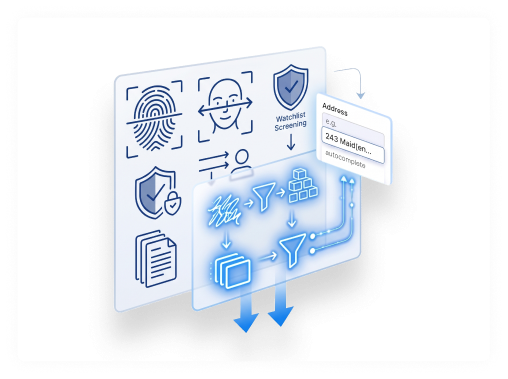
Look at where the compliance budget goes in most fintechs: document fraud detection, biometric liveness checks, watchlist screening, and ongoing transaction monitoring. All of these are necessary and solve genuinely hard problems, but almost none of them address the point where a lot of onboarding friction actually starts: whether the address a customer typed exists at all.
According to Azakaw, a KYC and AML technology provider, the average KYC abandonment rate ranges from 25% to 40%, often due to slow checks, unclear instructions, or document friction. While thorough identity verification is necessary, many drop-offs stem from unvalidated address fields that accept any input. This causes errors to surface downstream as failed matches, proof-of-address requests, or stalled manual reviews.
The identity check is not what breaks first
Most KYC and KYB literature understandably focuses on the hard part: is this document real, is this face live, and is this business what it claims to be? Parcha's own guide to proof-of-address verification makes the point that proof-of-address documents such as utility bills and bank statements are among the easiest KYC materials to forge, and treating them as a routine checkbox is a genuine risk.
That's true, but it's a different problem from the one that trips up most applicants. Long before anyone gets to a forged utility bill, a huge number of onboarding flows fail on something much simpler: the applicant typed an address that doesn't parse cleanly or that the system can't match to a real UK property, and the flow either blocks them or waves the problem through to a manual reviewer. Sophisticated fraud detection built on top of an unvalidated address field is still built on top of an unvalidated address field.
The rest of the industry is solving the step after this one
Vendors like Socure and Regula have built impressive capability into identity verification, cross-referencing documents, biometrics, device signals, and address data into a single risk score. Socure's own Address RiskScore product treats address as one signal among many in a fraud model, which makes sense once you're deep into a verification stack. But that's a step further down the funnel than where most address problems actually originate.
The upstream problem is much duller: does this address exist, is it complete, and is it in a shape your systems can actually use? It's a data quality question, and it's the one almost nobody in the identity verification space is set up to answer at the point a customer is typing it in.
Fixing the address field doesn't mean fixing your KYC stack
None of these points is an argument for ripping out document verification, biometrics, or watchlist screening. Instead of replacing your existing compliance stack, you can improve it by adding an address field that returns a real, structured UK address from the start, rather than relying on free-text entry.
That means postcode lookup and autocomplete at the point of capture, so an applicant picks a real address in three keystrokes rather than typing one from scratch. Add validation against official UK address data on top so that what reaches your KYC stack is a properly formatted result rather than a string of characters that might or might not correspond to anywhere. It's a fix that sits in front of your existing compliance stack.
Why this stops being optional in November 2026
From November 2026, structured address data becomes a compliance requirement in its own right. The Bank of England will reject fully unstructured postal addresses submitted through CHAPS, in line with the ISO 20022 messaging standard already being adopted across SWIFT CBPR+ and the SEPA schemes. In practice, that means town and postcode need to arrive in their own fields, not buried inside a single free-text address line.
If your onboarding or payments flow still captures the address as a single block of text, it's going to become a payments compliance issue. Fixing the address field at the point of capture solves this problem, since a properly structured, validated address is precisely what CHAPS, SWIFT CBPR+ and SEPA now expect.
The fix without the rebuild
AddressBrain doesn't verify documents, run biometric checks, or screen against watchlists, and it isn't trying to. What it does is the critical part before all of that: postcode lookup, autocomplete, and validation built on officially licensed Royal Mail data, so users pick a real address in seconds, and your systems receive it already split into proper fields, ready for whatever compliance check comes next.
Try our postcode lookup and validation API for free, or go straight to the developer docs if you'd rather see the integration first.