
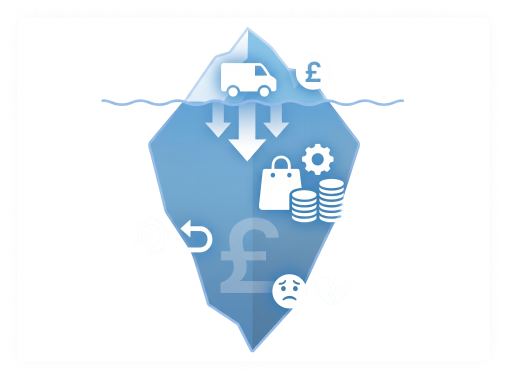
The most reliable estimate, provided by IMRG's Head of Logistics Andrew Starkey, values the annual cost of failed deliveries to UK retailers and online merchants at over £1.6 billion in avoidable losses.
IMRG's Valuing Home Delivery Review also found that lost orders are the most expensive single outcome of a failed delivery, averaging £147.14 each, and that retailers carry the biggest share of that cost. Everyone assumes the courier absorbs the cost of a failed delivery, but that's not really the case. Here's where the money and the pain actually land.
The courier's share: smaller than you'd think
A courier absorbs the cost of a second attempt – fuel, driver time, and a bit of vehicle wear. That's real, but it's also the cheapest part of the failure to fix, and couriers have spent the last few years building infrastructure specifically to avoid paying it twice: predicted delivery windows, out-of-home collection points, and weekend slots.
Where couriers do pay is reputationally and regulatorily, not per-parcel. Ofcom fined Royal Mail £21 million in 2025 for missing delivery targets, and Citizens Advice's November 2025 parcel league table ranked Evri and Yodel at the bottom of the five largest operators for delivery, accessibility, and trust. That's a high cost to the carrier's brand and regulatory standing, but it won’t show up in your P&L when an order fails.
The retailer's share: the one nobody budgets for
Retailers carry the largest share of a failed delivery's cost, and it's the least visible part of the bill. A failed delivery on your books means a redelivery to arrange, a customer service ticket to answer, a refund or reship to process, and a sale that has now cost more to fulfil than it made in margin.
Ofcom's own data on small and medium-sized businesses shows the squeeze is getting worse, not better: satisfaction with Royal Mail's overall service among SMEs dropped from 79% in 2022/23 to 74% in 2023/24. For a small retailer running on thin margins, a failure rate that ticks up by even a percentage point is a real dent in what's left after costs, and unlike a large retailer, there's no logistics team spreading that cost across a wider operation.
The customer's share: paid in time, not money
Customers aren't billed for a failed delivery, but they pay for it anyway, just not in a way that shows up on an invoice. Ofcom's 2024/25 monitoring found that while 78% of consumers were "generally satisfied" with parcel services, 68% had experienced a delivery issue in the previous six months. The same briefing cites Citizens Advice, which found that of those who ran into a problem, 47% then faced further issues trying to get it resolved: slow responses, automated systems, and having to contact the operator more than once.
That's the customer's share of the cost: chasing, waiting, and explaining the same problem twice. It's also the part of the failure that costs a retailer the most in the long run, because a customer who's just spent an afternoon on hold isn't thinking about your product quality; they're thinking about whether to order from you again.
Why the cost lands in the wrong place
None of this is really about couriers being careless or retailers being negligent. It's about where in the process we actually catch a failure. A failed delivery is expensive precisely because it's discovered after the parcel has already left the warehouse when redelivery, refunds, and customer service are the only options left.
Address errors are one of the most common, and most preventable, root causes of a failure that gets caught this late. An error that would take a fraction of a second to catch at checkout instead travels all the way through picking, packing, and dispatch before it surfaces as a driver standing at the wrong door.
The fix: catch the problem before the parcel leaves
Every part of the cost breakdown above happens after despatch. The only genuinely cheap fix is catching an address problem before the order gets that far.
AddressBrain validates UK addresses at the point of entry, not after the fact: postcode lookup, autocomplete, and validation are built on officially licensed Royal Mail data, so what reaches your warehouse is a structured, already-confirmed address rather than a guess that only gets tested when a driver's outside the wrong flat.
It's the same principle we covered in the five-minute checkout audit: the cheapest place to fix an address is the checkout, because every stage after that only makes the fix more expensive.
Try our postcode lookup and validation API for free, or take a look at the developer docs.