
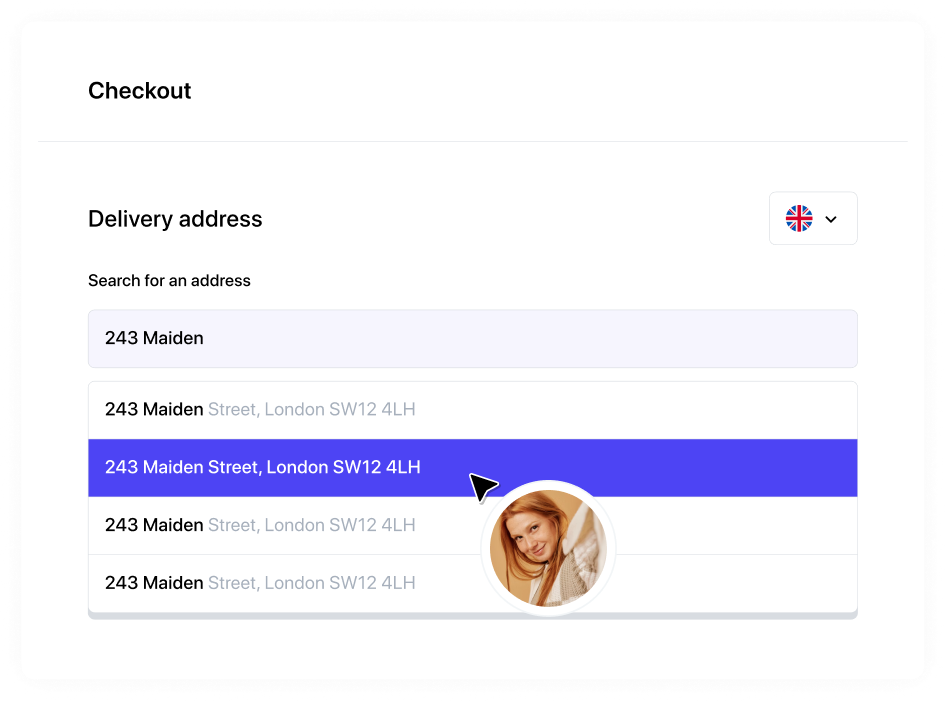
Address entry is one of the last places in a checkout flow where customers still fill in a form the way they did in 2010: freehand, unaided, and hoping for the best.
According to independent address verification research, 20% of addresses entered online contain errors. On a UK checkout, that ends in failed deliveries, support tickets, and customers who blame your business rather than their
own typo.
None of the five checks below need a design sprint or a developer roadmap slot. They need five minutes and an honest look at your own form.
Can shoppers find their address without
typing it out?
Type the first line of an address into your checkout right now. Does the form offer to finish it for you, or does it wait patiently while you type out every word of a flat number, a street name, and a town?
A free-text address field puts the entire burden of accuracy on the customer.
Postcode lookup and autocomplete remove that burden by turning a UK postcode or partial address into a list of real matches.
UPS's Pulse of the Online Shopper research found that adding autofill to address fields increases form completion by 25%, and the Baymard Institute puts the reduction in completion time at 30%. That's the difference between a customer finishing checkout and a customer abandoning it.
If your form still asks someone to type their full address from scratch, this is the highest-priority fix on this list.
Does the form catch a bad address before
it becomes a failed delivery?
Capturing an address and validating one are different jobs, and most checkout forms only do the former.
A field that accepts anything typed into it will happily accept a misspelt street, a postcode that doesn't exist, or a house number that doesn't match the postcode. None of that shows up as an error at checkout, but it will show up two days later as a failed delivery, and by then it's your courier, your support team, and your margin that absorb the cost. Loqate's research on failed deliveries found that when addresses are inaccurate or incomplete, 39% of deliveries fail outright and 41% arrive late.
Check whether your form actually confirms the address exists and cross-reference it against official UK address data, rather than simply storing whatever was typed. If it doesn't, you're finding out about bad addresses at the most expensive possible moment: after dispatch.
Are you asking for fields you don't need?
Count the address fields on your checkout. If you're a UK-only business and you're still showing a country dropdown, a county field, or a third address line by default, you're adding friction for a fix that solves nothing.
Every extra field is another chance for a customer to second-guess themselves, mistype something, or simply give up. UK addresses resolve cleanly from a postcode and house number or name in the vast majority of cases. Extra fields should appear only when they're genuinely needed, such as a flat number or a business name, not as a default wall of boxes every customer has to get past.
If you can't explain why a field exists, test taking it out and monitor what happens to your completion rate.
Does it cope with the addresses that break most forms?
Most checkout forms are built and tested against a tidy example address: a house number, a street and a town. However, real UK addresses are messier than that. Subdivided buildings, flats above shops, new-build estates that haven't reached the postcode database, and business addresses with a company name as the first line all trip up forms that only expect the tidy version.
New-build properties are a particularly common gap, since they can sit outside standard address data until it's updated. If your checkout has no answer for "the postcode exists but the address doesn't, you're pushing the customers most likely to have a delivery problem into a scenario that's most likely to cause one.
What happens to the address after checkout?
The address doesn't stop mattering once the order's placed; it gets pulled by your warehouse, printed on a label, and handed to a courier. Each of those steps depends on the data being structured, not just present.
If what's stored is a single block of raw text typed by the customer, every downstream system has to guess how to split it into the fields it actually needs. If it's structured and validated at the point of entry, with clean street, town and postcode fields, your warehouse and courier are working from the same accurate record the customer confirmed at checkout.
Check what your order management system actually receives. If it's a text blob rather than structured data, the problem you fixed at checkout is going to reappear further down the line.
Fix what the audit found
None of this requires rebuilding your checkout, but it does require the address field doing three things it currently
might not:
- Suggesting real addresses as the customer types
- Validating what's entered against real UK address data
- Handing your systems structured data rather than guessing
AddressBrain does all three from a single API: postcode lookup, autocomplete and validation, built on officially licensed Royal Mail data.
Start with a free 30-day trial: 30 lookups a day, no card required.
If one or two of the checks above flagged something on your own form, try out our autocomplete and validation API for free or take a look at the developer docs.