
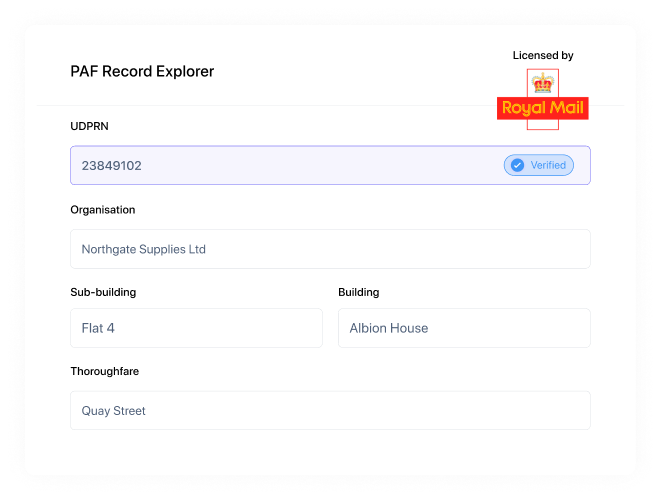
PAF stands for Postcode Address File. It's Royal Mail's database of every address in the UK that receives post, with over 30 million addresses and 1.8 million postcodes, and it's the file on which UK deliveries run.
If you've typed a postcode into a checkout and picked your house from a list, the list most likely came from PAF. Banks, insurers, retailers and councils use it to capture addresses accurately, and most get it through a third-party product rather than directly from Royal Mail.
This guide covers what's in the file, how Royal Mail keeps it current, how licensing works and how to check that the address data you're using is licensed.
What's in PAF
Royal Mail's PAF Programmers' Guide describes the file as a database of all known UK addresses and postcodes. Each record is a delivery point, which is anywhere Royal Mail delivers to: a house, a flat, a business or a PO box.
Each address is stored as a set of named elements rather than as lines of text. There's a sub-building name for a flat, a building name and number, the street (known as the thoroughfare), the locality, the post town and the postcode, plus an organisation name for businesses. We've walked through how those elements map onto a web form in our recent blog, ‘Address line 1 and 2 explained’.
The blog also breaks down the postcode system that sits around the addresses. At the time it was published, PAF covered:
- 124 postcode areas, the letters at the start of a postcode, such as BS for Bristol
- about 2,980 postcode districts and 11,159 sectors
- 1,661 post towns and just over 30,000 localities
- an average of 15 delivery points per residential postcode
Some addresses aren't in PAF. The guide lists British Forces (BFPO) addresses and any place without its own delivery point among the exclusions, and the file doesn't cover the Republic of Ireland.
UDPRN and other identifiers in PAF
Every delivery point in PAF carries a UDPRN, short for Unique Delivery Point Reference Number. Royal Mail introduced it because the older internal address keys could change when an address was amended, which made them unreliable for anyone linking their own records to PAF. A UDPRN gives each delivery point a reference that survives those changes, so it's the field to store if you want to match a customer record back to Royal Mail's data later.
Each delivery point also has a Delivery Point Suffix (DPS), a two-character code that, combined with the postcode, identifies one delivery point. Large business users that get their own postcode always have the suffix 1A.
UPRNs are a separate thing: the Unique Property Reference Number comes from Ordnance Survey's AddressBase products, not from PAF, and identifies properties and other locations whether or not they receive post.
Other Royal Mail address files
PAF itself is the main file, and Royal Mail sells several related datasets alongside it:
- Multiple Residence lists the individual flats or households behind a single front door, where PAF only records how many there are.
- Not Yet Built covers planned new developments before they're added to PAF.
- Alias holds the extra details people often put in addresses that aren't needed for delivery, such as counties.
- Welsh alternative addresses give Welsh-language versions where they exist.
These come with their own licence terms, so a provider that offers PAF won't necessarily offer all of them.
Who maintains PAF, and how it stays current
Royal Mail owns and maintains PAF. Under section 116 of the Postal Services Act 2000, the owner of the file has to maintain it and make it available to anyone who wants to use it on reasonable terms, and Ofcom has reviewed how Royal Mail meets that obligation.
New addresses start with the local authority, which assigns street names and numbers for new developments. Royal Mail then assigns the postcode, and the address goes into PAF once the local delivery office confirms it can receive mail. Royal Mail says it makes around 5,000 updates to PAF every day, with its delivery staff checking addresses as they go.
For organisations that hold a copy of the file, Royal Mail issues business changes files that can be applied daily, monthly or quarterly, or a full replacement copy. How current any particular product is depends on how often its provider applies those updates, so it's a fair question to ask.
How PAF licensing works
Everyone who uses PAF data needs a licence, whether they use it directly or through someone else's product. Royal Mail's licensing centre sets out the main routes:
- Direct End User licence. An organisation buys a licence from Royal Mail and takes the data itself, which suits large organisations with their own data teams.
- Through a Solutions Provider. Most businesses use PAF inside a licensed provider's product, such as an address lookup API. The provider holds a solutions provider licence, works out the end-user licence fees and reports them to Royal Mail.
- Corporate, public sector and charity licences. Royal Mail offers a single licence for a parent company and its subsidiaries, and a separate licence for public sector bodies. Eligible UK charities and community interest companies with income under £10 million may be able to get PAF data free for non-commercial use.
Some products, including Part PAF (a subset of the file), are only available through a solutions provider. Royal Mail publishes its fees on its pricing pages, and for most smaller teams, a provider is the practical route because it runs the infrastructure and handles the licence reporting.
How to check if your address data is licensed
A postcode lookup that works doesn't tell you where its data came from. Some low-cost services have used address data without the licence Royal Mail requires, and the businesses relying on them carry the risk when that comes to light.
Before you build on an address provider, ask them to confirm these on the record:
- Are you a licensed Royal Mail PAF Solutions Provider? Royal Mail keeps a directory of licensed providers, linked from its licensing centre, so you can check this.
- How is my end user licence covered? A licensed provider should be able to explain how your usage is licensed and reported to Royal Mail.
- How often do you apply Royal Mail's updates? This information tells you how quickly new addresses will reach your forms.
The risk isn’t hypothetical. In October 2025 the High Court found that a competing UK address lookup service had used Royal Mail's address data without the licence it needed. We covered the judgement and what it means for anyone building with address data in your AI agent is about to autofill someone's address, but is the data behind it licensed?
Where AddressBrain sits
AddressBrain is a UK address lookup and validation API, officially licensed via Royal Mail PAF. The licensing question sits with us, so your team gets Royal Mail's data through a plain REST API without taking out its own licence or running the file itself.
Lookups return structured PAF fields, so you can fill a form, store the elements and match records back to Royal Mail's data later. You can see the fields in the API reference.
Frequently asked questions
What does PAF stand for?
PAF stands for Postcode Address File. It's Royal Mail's database of UK addresses and postcodes.
What is PAF data?
PAF data is the address and postcode information held in the Postcode Address File. Each address is stored as structured elements, such as building number, street, post town and postcode, along with references like the UDPRN.
Is the Royal Mail PAF free?
Not usually. Commercial use needs a paid licence, either directly from Royal Mail or through a licensed solutions provider. Eligible UK charities and community interest companies with income under £10 million may be able to use it free for non-commercial purposes.
How often is PAF updated?
Royal Mail continuously updates PAF, making around 5,000 changes a day. Organisations holding a copy can apply the changes daily, monthly or quarterly.
What is PAF validation?
PAF validation means checking an address against the Postcode Address File to confirm it exists and is written the way Royal Mail holds it. It catches typos, missing flat numbers, and addresses that don't exist before they reach your database.
Does PAF include UPRNs?
No. UPRNs come from Ordnance Survey's AddressBase products. PAF uses its own identifier, the UDPRN.